24/7 emergency response across Essex County, usually on site within the hour

Toilet overflow cleanup Newark NJ, done before the water spreads

When a toilet backs up at 2 a.m. in Newark, every minute soaks deeper into your subfloor. We run toilet overflow cleanup Newark NJ the way it should be run: extract the water, sanitize the mess, and dry the structure so mold never gets a foothold. Our crews handle toilet water damage cleanup in Newark, NJ for homeowners, landlords, and property managers across Essex County, and we answer the phone around the clock.

↗
Fast online booking

Request service today

Tell us what is happening. Our local team will confirm your visit shortly.

No spam. No obligation. Just practical help.
Thanks — we'll call shortly to confirm your visit.
Water Damage Restoration Near Me for Newark homes
Careful work. Honest options.
About this service

What toilet overflow cleanup Newark NJ actually involves

Toilet overflow cleanup Newark NJ is the process of extracting standing water, removing contaminated materials, and drying a bathroom and the rooms below it after a toilet overflows or backs up. It is not a mop-and-bucket job. Category 3 black water carries bacteria and viruses, so we treat every overflow as contaminated until testing says otherwise. We pump out the bowl and tank, extract the floor water with a truck-mounted water extractor, pull baseboards and wet drywall, then set commercial dehumidifiers and air movers to dry the cavity. A moisture meter and thermal imaging camera confirm the structure is dry, not just the surface.

Most Newark overflows we see start small and get expensive fast. A worn flapper valve runs all night. A clogged main line backs up into a first-floor bathroom during a dinner party. In the Ironbound's older two- and three-family homes, a second-floor overflow often rains straight through the ceiling below. If you are searching for emergency toilet overflow cleanup Newark at 3 a.m., that is exactly when we are working. We also handle sewage toilet overflow cleanup Newark New Jersey when the backup comes from the city main rather than the fixture itself.

  • ✓ Response in under an hour
  • ✓ Contaminated water handled right
  • ✓ Drying verified, not guessed
  • ✓ Paperwork your insurer accepts
What's included

What our toilet overflow cleanup includes

Every toilet overflow cleanup in Newark starts with the same core scope: extract the water, remove what cannot be saved, sanitize, and dry the structure to standard. What changes is how far the water traveled and whether it is clean or contaminated. Here is what is included on a standard job.

✓

Emergency water extraction

We pump the bowl and tank, then pull standing water with a truck-mounted water extractor. On a standard bathroom overflow, extraction takes two to four hours. We also check the hallway, closet, and ceiling below for water that migrated out of the bathroom.

✓

Contaminated material removal

Category 3 water means porous materials that soaked it up cannot be saved. We cut out affected drywall, insulation, and flooring, bag it, and dispose of it per NJ DEP regulations. This is the step that prevents mold and odor problems down the road.

✓

Antimicrobial treatment

Every affected surface gets antimicrobial solution after extraction and removal. We treat the subfloor, wall plates, and any framing that was exposed. This is not a bleach wipe-down; it is a full application designed to stop bacterial growth before drying begins.

✓

Structural drying with daily monitoring

We set commercial dehumidifiers and air movers, and run a HEPA air scrubber in occupied areas. Drying runs three to five days. A technician checks moisture readings daily with a moisture meter and thermal imaging camera, and we adjust equipment placement as the structure dries.

✓

Insurance documentation

We photograph every affected area before, during, and after. We log daily moisture readings and build the scope in Xactimate. You get a complete claim package that your adjuster can process without chasing us for missing information.

✓

Final verification and walkthrough

We do not remove equipment until the moisture meter confirms the structure is dry to IICRC S500 standard. Then we walk you through the space, show you the final readings, and lay out the rebuild scope: drywall, flooring, silicone sealant, and paint.

How it works

What to expect from start to finish

01

Call and triage

You call (973) 973-2565 and reach a live dispatcher, not a voicemail. We ask what overflowed, how far the water spread, and whether the backup is sewage. That tells us what equipment to load. We give you a realistic arrival window and tell you what to do while you wait: shut off the supply valve, stop using other fixtures on the line, and keep people off the wet floor.

02

Inspection and scope

A technician walks the space with a moisture meter and thermal imaging camera, checking the bathroom, the hallway, and the ceiling below. We find the source, confirm whether it is a fixture clog or a main-line backup, and map the affected area. You get the scope and the price before we start work, not after.

03

Extraction and removal

We pump the bowl and tank with a submersible pump, then pull standing water with a truck-mounted water extractor. Contaminated drywall, insulation, and flooring that cannot be saved get cut out and bagged. This step usually takes two to four hours on a standard bathroom overflow.

04

Sanitize and dry

Every affected surface gets antimicrobial solution. We set commercial dehumidifiers and air movers, and run a HEPA air scrubber in occupied areas. Drying typically runs three to five days. We check moisture readings daily and adjust equipment placement as the structure dries.

05

Final verification and rebuild

We do not call it done until the meter reads dry. Once it does, we remove equipment, document the final readings, and walk you through the rebuild scope: new drywall, replacement flooring, silicone sealant at the fixture base, and paint. If you want us to handle the repairs, we do that too.
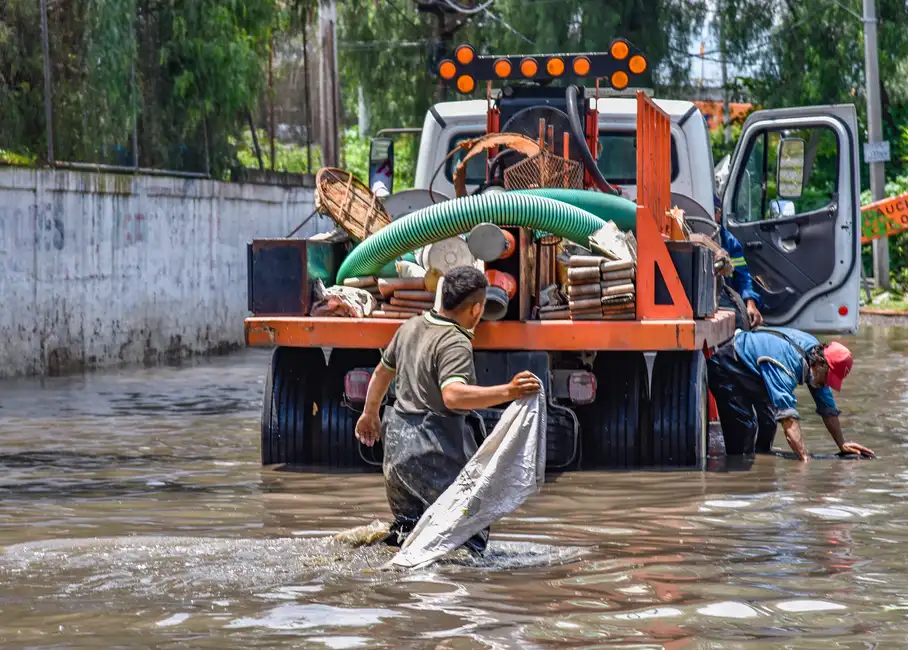
Tools & methods

Tools and methods we use

Purpose-built equipment, used by trained technicians — so the job is done accurately the first time.

Truck-mounted water extractor

Pulls hundreds of gallons of standing water per hour from bathrooms, hallways, and basements. This is the first piece of equipment on the job and the one that saves the most flooring.

Submersible pump

Used to empty the toilet bowl and tank, and to pull water from low spots where a standard extractor head cannot reach. Essential when the overflow is a sewage backup.

Commercial dehumidifier (Dri-Eaz, Phoenix Restoration Equipment)

Removes moisture from the air so the structure can dry. We size the unit to the cubic footage of the affected space and run it until moisture readings hit dry standard.

Air mover

Directs high-velocity air across wet surfaces and into wall cavities. Placement matters more than quantity, so we map the airflow before we set the units.

Moisture meter and thermal imaging camera

Used together to find hidden moisture behind walls and under floors. The thermal camera shows temperature differences; the moisture meter confirms actual water content. We log readings daily.

HEPA air scrubber and negative air machine

Pulls airborne bacteria, mold spores, and dust out of the air. Critical on Category 3 jobs, where contamination is the main health risk. We run these in occupied areas to protect the rest of the home.

Inspection camera

Lets us see behind walls and under floors without unnecessary demolition. We use it to find the source of the overflow and to confirm the extent of the water path before we cut anything open.

Real results

Before and after.

Second-floor overflow in Ironbound three-family

Before

A tenant's toilet overflowed overnight and ran for six hours before anyone noticed. Water soaked the bathroom floor, spread into the hallway, and dripped through the ceiling of the unit below. The first-floor tenant had a visible ceiling stain and wet carpet.

After

We extracted standing water from both floors, cut out the wet ceiling drywall, and set drying equipment on both levels. Four days later, moisture readings hit dry standard. We replaced the ceiling drywall, repainted, and replaced the hallway flooring. Both units were back in service within a week.

Sewage backup in Weequahic basement bathroom

Before

Heavy rain overwhelmed the city main and sewage backed up through a basement toilet. The floor was covered in contaminated water and the smell was strong. The homeowner had tried to mop it up with bleach, which did not address the contamination or the moisture in the walls.

After

We treated it as Category 3, used full PPE, extracted the water with a submersible pump and truck-mounted extractor, and bagged all contaminated materials. After antimicrobial treatment and four days of drying with commercial dehumidifiers and a HEPA air scrubber, the basement tested dry and odor-free.

Supply line failure in Vailsburg bathroom

Before

A galvanized supply line behind the toilet failed and soaked the wall and floor for an estimated 12 hours before the homeowner got home. The drywall was soft to the touch and the baseboards were swollen. There was no visible mold yet, but the wall cavity was saturated.

After

We found the leak with an inspection camera, stopped it, and removed the wet drywall and baseboards. The wall cavity and subfloor dried in three days with directed air movers and a commercial dehumidifier. We replaced the drywall, installed new baseboards, and repainted the bathroom.

Problems we solve

Problems we solve after a toilet overflow

A toilet overflow is rarely just a wet floor. It is a chain reaction: water spreads, materials soak, mold starts, and the damage bill climbs. Here are the specific problems we solve for Newark customers every week.

Ask a pro →
01

Water soaked into the subfloor and will not dry

We extract standing water, then set commercial dehumidifiers and air movers directed at the subfloor. A moisture meter tracks the drying progress daily. If the subfloor is too far gone, we cut it out, dry the joists, and replace it before new flooring goes down.

↗
02

Sewage backup contaminated the bathroom and hallway

We treat it as contaminated from the first minute. Full PPE, bagged removal of porous materials, antimicrobial solution on every surface, and a HEPA air scrubber running in occupied areas. We follow ANSI/IICRC S500 on every step.

↗
03

Water reached the ceiling below and left a stain

We open the ceiling, dry the cavity with directed air movers, treat the framing with antimicrobial solution, and verify with a moisture meter before closing it back up. Then we repair the drywall and paint to match.

↗
04

Insurance claim stalled because documentation was thin

We photograph everything, log daily moisture readings, and build the scope in Xactimate. Your adjuster gets a complete package. We can also walk you through the claim before you file so nothing gets missed.

↗
Proof you can check

Licensed, certified, and documented

✓
IICRC WRT (Water Restoration Technician)Institute of Inspection, Cleaning and Restoration Certification
✓
IICRC ASD (Applied Structural Drying)Institute of Inspection, Cleaning and Restoration Certification
✓
IICRC AMRT (Applied Microbial Remediation Technician)Institute of Inspection, Cleaning and Restoration Certification
✓
New Jersey Home Improvement Contractor LicenseNew Jersey Division of Consumer Affairs
✓
New Jersey Mold Remediation Contractor LicenseNew Jersey Department of Health
Good questions

Frequently Asked Questions

(973) 973-2565 →

Most residential toilet overflow cleanups in Newark run $350 to $1,200 in 2026, depending on square footage, water category, and how far the moisture spread. A single bathroom with clean supply-line water sits at the low end. A sewage backup that reaches the ceiling below and requires drywall removal and antimicrobial treatment sits at the high end. We give you the scope and price before we start, and we bill insurance directly when the claim covers it.

SwiftReclaim does, 24 hours a day. We are based in Newark and cover every neighborhood from Downtown and Ironbound to Weequahic and Vailsburg. Call (973) 973-2565 and a live dispatcher will confirm your address, tell you what to shut off, and give you an arrival window. Most Newark addresses see a crew inside 60 minutes.

Usually yes, if the overflow was sudden and accidental. Most homeowner policies cover sudden toilet supply-line failures and unexpected backups. What they often do not cover is long-term seepage you knew about and ignored. We photograph everything, log moisture readings, and build the scope in Xactimate so your adjuster has what they need. We can also walk you through the claim before you file.

Extraction takes two to four hours on a standard bathroom overflow. Structural drying runs three to five days, with daily moisture checks. If the water reached the ceiling below or soaked into a slab, plan on the longer end. We do not pull equipment until a moisture meter and thermal imaging camera confirm the structure is dry to IICRC S500 standard.

Ready when you are

Call now for toilet overflow cleanup Newark NJ

Every minute the water sits, it wicks deeper into your subfloor and the ceiling below. We answer 24/7, we give you the price before we start, and we document everything for your insurance claim. Call (973) 973-2565 and we will get a crew rolling to your Newark address.

Call Now (973) 973-2565 →
Request an appointment

Contact SwiftReclaim in Newark

Call us any time at (973) 973-2565 for emergency water damage restoration in Newark. We answer 24/7 and dispatch crews around the clock. For non-emergency questions or to schedule an inspection, email info@swiftreclaim.com or stop by our office. We serve all of Newark and Essex County.

Request received — our team will be in touch shortly.
Tap to call(973) 973-2565